
Calhoun County Arrest Warrants Explained
An arrest warrant comes from a magistrate, in writing. Texas Code of Criminal Procedure Chapter 15 spells out how it works: a complaint or affidavit states the sworn facts, the document identifies the person and the offense, and the magistrate must have legal authority to act. Once signed, it tells a peace officer to bring the named person into custody. That paper is not the court outcome; it starts the case rather than ending it. No single Calhoun County office opens every warrant, since the case type and the court decide where the record lives. For the state framework, read Chapter 15 yourself.
Calhoun County’s Three Court Layers
Calhoun County stacks its courts in three layers. The 24th, 135th, and 267th Judicial District Courts sit at the top, handling felonies and general-jurisdiction matters, with the District Clerk keeping their criminal files. County Court at Law No. 1 takes misdemeanors and several other listed matters, and it has its own County Clerk and a separate court-coordinator route. Below that, the JP and municipal courts work the high-volume stuff: Class C cases, traffic, ordinance violations, and failure-to-appear matters. So start with the court named on your citation or case notice. A capias pro fine from a lower court is its own animal, and calling it a district arrest warrant just because an officer can execute it gets the record wrong. Calhoun's court directory routes you to each office.
Inside a Calhoun County Arrest Warrant
What you see in a public interface is often just a slice of the court's full record. Calhoun County publishes no universal arrest-warrant form and no countywide field list. The items a clerk may need to pin down an entry vary by court. The Port Lavaca municipal PDF is a different record and does not show every field.
| Issuing court | District, County Court at Law, JP, municipal court, or authorized magistrate. |
|---|---|
| Case identifier | Cause number or citation number that links the process to a file. |
| Offense and issue date | Information required to identify the process in the court record. |
| Magistrate | The judge or official who issued the written order. |
| Service and return | May show execution or return; service does not close the underlying case. |
| Bond or release | Case-specific. No current countywide bond schedule was located. |
| Recall or access limit | Ask the issuing court about a later order or a sealed record. |
Chapter 15 Sets the Warrant Paper Trail
Chapter 15 supplies the statewide frame for any arrest warrant. In plain terms, sworn facts support a complaint, an authorized magistrate reviews the legal basis, and the resulting order identifies the accused and the offense as the law requires. The filing route can vary by case. The Sheriff is not the source of every warrant, and Calhoun County has no Sheriff-specific warrant form. The statute itself, not a local warrant or a person's file, is the legal source.
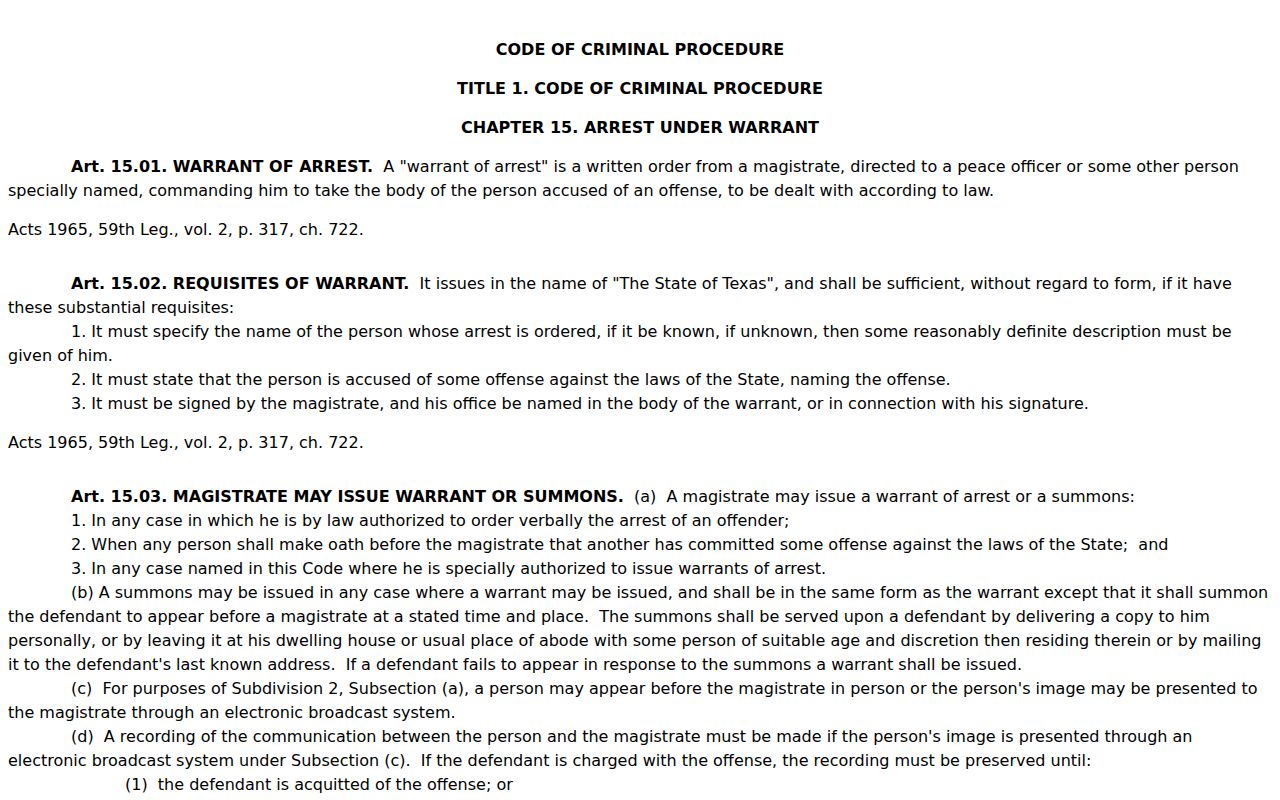
Ask the District Clerk or County Court at Law which public docket fits the case, then confirm warrant status with that Calhoun County office.
Serving Arrest Warrants in Calhoun County
Several hands can serve a warrant in Calhoun County. The Sheriff, constables, city police, and other authorized peace officers all may execute process, depending on the issuing court and the legal authority behind it. No public source maps each warrant to a specific agency. An agency's contact page helps route a records or service question, though only the issuing court can recall its own order.
211 S. Ann Street, Port Lavaca. General office: 361-553-4646.
302 W. Live Oak, Port Lavaca. Custody routing: 361-553-4475.
Port Lavaca, Seadrift, and Point Comfort publish separate agency contacts.
Use the county law-enforcement directory for official agency routes in Calhoun County. The issuing court can say who is listed for a specific matter.
Comparing Arrest, Summons, and Bench Warrants
These papers demand different responses. An arrest warrant commands custody. A summons just directs a person to answer or appear. "Bench warrant" is everyday speech for court process issued after a missed appearance or similar event. Public records use the terms loosely, so in Calhoun County ask the clerk to identify the actual order and the case stage.
| Document | What it generally does | Calhoun confirmation route |
|---|---|---|
| Arrest warrant | Directs an officer to take a person into custody. | Issuing magistrate or criminal court. |
| Summons | Notifies someone to answer or attend a proceeding. | Court named on the notice. |
| Bench or FTA process | Responds to a missed appearance or court requirement. | Court that set the appearance. |
| Capias pro fine | Enforces an unpaid lower-court judgment under Texas law. | JP or municipal court that entered judgment. |
Calhoun County Search Tools Have Limits
Two online tools cover part of the Calhoun County picture, and neither one is a full arrest warrant index. Tyler Odyssey tracks criminal and civil case records, and County Court at Law guidance suggests searching last name, first name, with an asterisk after a partial name. Port Lavaca's vendor handles city citations only. The Sheriff's "Current Inmate List" link reports custody, not every unserved warrant in Calhoun County. A blank result can mean limited scope, thin indexing, a sealed matter, or simply a different court. So call the District Clerk at 361-553-4630 for district records, or County Court at Law at 361-553-4640. City and JP cases belong to the clerk named on the citation. Whatever you find, keep the source and date with the result.
Sealed and Juvenile Records Have Limits
Some warrant records simply are not public. Texas Government Code Chapter 552 carves out law-enforcement exceptions, and Family Code Chapter 58 adds strict juvenile confidentiality rules. A court can seal a file or issue its own order too. A missing result proves nothing about whether the underlying process exists. For an open record or a question about office policy, Calhoun County's PIA form asks for a description and your contact information. The statute itself governs what gets released. Never request juvenile data, and never publish it.
Ask Before a Planned Appearance
Ask first if a warrant might be active. An attorney or the issuing clerk can tell you whether a planned appearance, motion, bond, or other step makes sense. Calhoun County publishes no countywide surrender hours, no general bond window, and no public bond schedule. Adult Detention can route a custody question. The court still controls the case and its warrant.
Do not rely on a public search alone when a current arrest process may be involved. Get a court or attorney instruction before making an in-person plan.
Keep the court order or receipt after any step. Ask when the docket should show it. A payment can settle a citation in Calhoun County without proving the warrant was recalled.
If There’s an Arrest Warrant for You
Facing a Calhoun County arrest warrant starts with paperwork. Write down the court, the case number, the offense label, and the source that reported it. Then ask the issuing court the questions that matter. Is the warrant active, served, recalled, or quashed? Is bond set, and what confirms a change in status? The court speaks with authority here. The Calhoun County Sheriff can answer service questions, and detention can answer custody questions, yet neither answer replaces a court order. Keep the steps separate: locate the file, confirm the current process, arrange any appearance, then verify the record afterward. A licensed Texas attorney can explain district or county court exposure in context.